- The Culture Vulture
- Posts
- Tokyo’s Sushi Showdown: Sumi vs Sushi Like by Kintan
Tokyo’s Sushi Showdown: Sumi vs Sushi Like by Kintan
From Tokyo-style sushi in Notting Hill to ghostly fabric homes and ancient mountain trails, this week’s edition travels through taste, art, history, and altitude.

Shakira Taylor
October 25, 2025

In partnership with

Hey Culture Clubbies!
This week we’re diving into London’s sushi scene: a capital city quietly (and rather confidently) becoming one of the best places outside Japan to indulge in Edomae craft. Two restaurants at opposite ends of the spectrum, Sumi in Notting Hill and Sushi Like by Kintan near Oxford Circus, are redefining what it means to enjoy sushi in London. Whether you’re hunting a zen-like omakase or something fast, fun, and still authentically Japanese, this face-off reveals just how multi-dimensional London’s sushi revolution has become.
In under 10 minutes we’ll cover:
Tokyo’s Sushi Showdown: Sumi vs Sushi Like by Kintan
Do Ho Suh: Walk the House
Halloween’s Global Evolution
Svaneti, Georgia: Highland Feasts and Hidden Trails
Let’s get started.

Join over 4 million Americans who start their day with 1440 – your daily digest for unbiased, fact-centric news. From politics to sports, we cover it all by analyzing over 100 sources. Our concise, 5-minute read lands in your inbox each morning at no cost. Experience news without the noise; let 1440 help you make up your own mind. Sign up now and invite your friends and family to be part of the informed.
Tokyo’s Sushi Showdown: Sumi vs Sushi Like by Kintan
Londoners have long adored sushi in every form, from roll-packed lunch boxes to singular omakase counters, yet few rivalries capture the city’s sushi divide as cleanly as Sumi in Notting Hill and Sushi Like by Kintan near Oxford Circus. Both are firmly grounded in Tokyo inspiration, but they interpret it through wildly different lenses: one polished, serene, and steeped in Michelin lineage; the other brisk, value-driven, and refreshingly democratic.
Together they frame how Japanese food philosophy evolves in London: precision versus pace, intimacy versus accessibility, craftsmanship versus casual mastery.

Sumi: Where Tokyo Precision Meets Notting Hill Ease
Sumi is the casual sibling to Sushi Kanesaka, one of Tokyo’s most respected Michelin-starred sushi institutions. From the moment you walk in, it’s clear this Notting Hill favourite takes pedigree seriously but never stiffly. Soft light filters through minimalist interiors of blond wood and pale stone, where an open prep counter centres the room. Guests perch at the counter or sink into low tables, observing deft hands sculpting rice into art. The team trained under Sushi Kanesaka’s ethos: that simple perfection lies not in invention, but in subtle harmony - each grain of rice, each cut of fish, a deliberate stroke.

The menu unfolds accordingly: omakase nigiri that changes with the tides, melt-in-your-mouth otoro (fatty tuna) that glistens with perfect marbling, and sashimi served with almost meditative precision. Portions arrive in quiet rhythm, small bursts of ocean flavor presented against minimalist ceramics.
The omakase menu, typically £60–£120 depending on market catch, remains the highlight, with the chef guiding diners through sequences of tuna belly, fluke, scallop, and sea bream, each brushed gently with soy or dusted with yuzu zest. It’s an experience that teaches patience: to slow your eating, to taste the temperature of rice, to feel its soft crumble against the clean cut of fish.

But Sumi, despite its roots, doesn’t treat tradition as a trap. Creative side dishes—crisp tempura, comforting miso broth, and Japanese pickles lining elegant dishes—make the place more approachable than its Michelin-bound parent. The balance between ritual and freedom is striking. You can sip sake from a small wooden masu or pair your sushi with light white wine. The staff, knowledgeable without condescension, weave detail into their service quietly. When describing an otoro nigiri, they’ll mention the supplier or the aging process, always with a note of pride but zero pretense.

There’s a fluid sophistication that fits Notting Hill’s rhythm: a blend of neighborhood ease and gastronomic ambition. Conversations murmur softly but never hush the space; couples, birthday groups, and solo sushi enthusiasts find comfort here. The crowd leans toward discerning locals and food lovers seeking an authentic Edomae experience without the formality of a tasting counter hidden in Mayfair.

Reservations are wise, the demand for tables can outstrip supply, especially on weekends when the omakase counter fills swiftly. Many guests consider Sumi a gateway to fine sushi, a place to learn the language of omakase, before plunging into Michelin hushedness.
Sushi Like by Kintan: Fast Hands, Fresh Rolls, No Fuss
A 20-minute tube ride east lands you near Oxford Circus, where Sushi Like by Kintan hums with a completely different energy. Small, efficient, and downright practical, the restaurant operates like a Tokyo commuter stop transplanted to central London. Its concept? Democratising great sushi.

The space is compact: polished counters, slim wooden stools, tight walkways—but everything moves with rhythm and efficiency. You grab a pencil, tick your choices on a menu sheet, hand it over, and within minutes the temaki begins to roll out. It’s high-speed precision, done with heart.

Part of the Japanese-owned Kintan group, best known for its yakiniku restaurants, Sushi Like emphasizes freshness and speed over ceremony. The focus here is temaki: crisp seaweed cones filled with freshly made rice and precisely seasoned ingredients.
The 6 Temaki Set (£25) is the star draw, stuffed with creative fillings: tuna, enoki mushroom, prawn tempura, fatty tuna with pickled radish, aubergine, eel, each offering a swift, satisfying crunch-snap between seaweed and rice. There’s delight in the simplicity: bite, chew, enjoy, move on. The seaweed remains crisp to the last roll because each temaki is rolled to order.
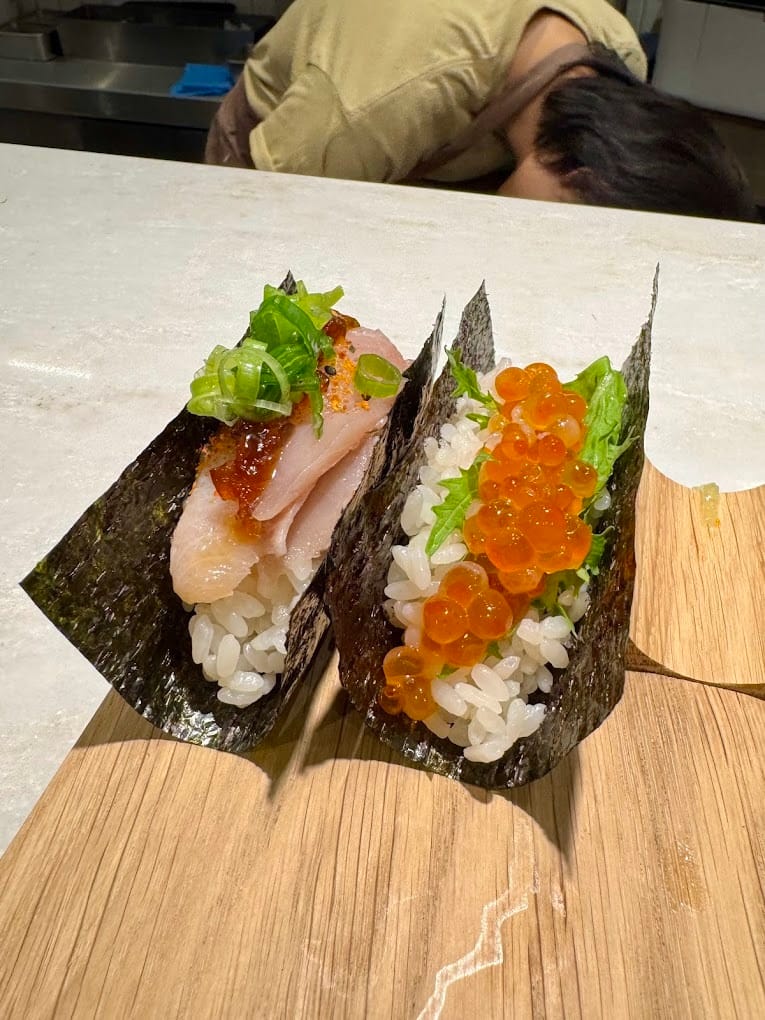
At these price points, the quality astonishes. The tuna has brightness, the eel sweet smokiness, the otoro surprisingly rich depth. Pair it with karaage chicken (£5), a scatter of seaweed salad (£3.80), or a simple bowl of miso soup (£3), and you’ve got an entire meal under £20 per person. There’s occasional flair too: uni on otoro making special appearances when available, instantly selling out on social media. You might find yourself sitting next to office workers in suits, a shopping couple sharing hand rolls, or solo diners enjoying a quick lunch before diving back into Oxford Street. Everyone moves with swiftness but somehow without chaos.

Service at Sushi Like by Kintan mirrors Tokyo’s efficiency. Staff dash gracefully behind the counter, sushi boards arriving seconds after order slips. Yet despite the speed, there’s courtesy baked into the system. Smiles, quiet greetings of “irasshaimase,” and perfectly packed takeaway boxes.
Where Sumi’s dining room breathes measured calm, Sushi Like buzzes with small bursts of energy. Reviewers adore it for what it achieves: hand rolls that stay crisp, rice perfectly seasoned every time, and fish that outpaces most high-street sushi in freshness. For many Londoners, it sits in the sweet spot between quality and cost—a perfect late lunch, pre-theatre bite, or midweek treat. And though queues may snake down Margaret Street during peak hours, that line tells you all you need to know.
The Verdict
Two restaurants. Same city. Both fulfil the Tokyo philosophy that good sushi should express purity, timing, and care. Sumi enchants with serenity and intention. Sushi Like by Kintan, on the other hand, invites everyone in: no reservations, no prolonged rituals, just human connection through freshness and flavour. Ultimately, Sumi and Sushi Like by Kintan reflect London’s plural personality: one restaurant where sushi feels like performance art, another where it becomes part of the city’s daily rhythm. And therein lies the beauty of London’s Japanese renaissance, it doesn’t force a choice between reverence and accessibility. It celebrates both.
Do Ho Suh: Walk the House
Imagine walking through a home made entirely of air and memory. This is the experience offered by Do Ho Suh: Walk the House, a major solo exhibition devoted to one of contemporary art’s most poetic sculptors of space. Hosted at The Tate Modern, the exhibition unfolds as a life-sized structural dreamscape in translucent fabric.
Viewers do not just look at Suh’s work—they live inside it, if only for a moment.

Do Ho Suh has long been preoccupied with what it means to belong. Born in Korea, educated in the United States, and based in London, the artist has made a career of translating the emotional weight of home into physical form. His signature technique involves creating full-scale models of his former residences, each meticulously sewn from colored polyester. When illuminated, these spectral rooms glow like x-rays of domestic life—door frames, light switches, and radiators suspended in soft transparency. In Walk the House, Suh refines this language even further, turning architecture into autobiography.

The installation invites visitors to physically move through a corridor of remembered places. Each section corresponds to one of Suh’s past homes, from Seoul to New York to London. Although every line and hinge is perfectly measured, the transparency of the materials lends a ghostly quality: structures that appear solid dissolve at a touch. Stepping through the mesh walls is like traversing a memory. The tactile sensation of walking through fabric doorways transforms something ordinary into a moment of quiet revelation.

What makes the exhibition particularly timely is how eloquently it speaks to today’s global condition of movement and dislocation. As more people live between cities, languages, and cultures, Suh’s work feels uncannily prescient. Walk the House offers a model for thinking about home not as a fixed address, but as an emotional architecture we carry within us. In its luminous detail, every stitch becomes a record of presence, a stand-in for skin, touch, and time.

Visitors can expect not only Suh’s monumental fabric reconstructions but also smaller pieces that echo their themes. Drawings, documentary films, and process models reveal the years of technical and emotional labor behind each work. For all its apparent lightness, the show requires careful navigation: the translucent corridors can disorient, making viewers conscious of their own movement through space. The result is contemplative rather than spectacular, an exhibition that rewards slowness.

For those encountering Do Ho Suh for the first time, Walk the House functions almost like an introduction to the artist’s world, where fragility and precision coexist. For returning admirers, it deepens the resonance of his ongoing exploration of identity through architecture. Each corridor and corner speaks of continuity and change, impermanence and attachment. Despite the ethereal materials, this is art anchored in emotion—one that asks you to literally step inside someone else’s sense of belonging.
Dates, opening hours, and ticket details are available via the hosting venue’s website. Whether experienced as a meditative walk or as a feat of conceptual engineering, Walk the House affirms Suh’s position as one of the most affecting chroniclers of modern migration and memory working today.
An espresso shot for your brain

The problem with most business news? It’s too long, too boring, and way too complicated.
Morning Brew fixes all three. In five minutes or less, you’ll catch up on the business, finance, and tech stories that actually matter—written with clarity and just enough humor to keep things interesting.
It’s quick. It’s free. And it’s how over 4 million professionals start their day. Signing up takes less than 15 seconds—and if you’d rather stick with dense, jargon-packed business news, you can always unsubscribe.
Halloween’s Global Evolution: From Celtic Rituals to Worldwide Costume Craze
Every October the world glows orange and black, streets fill with cobwebbed doorways, and jack-o’-lanterns flicker from São Paulo to Seoul. Yet the celebration that now fuels billions in candy sales began as something far quieter and far older. Halloween’s roots reach back more than two thousand years to Samhain, the Celtic festival that marked summer’s end in ancient Ireland and Scotland.

Samhain Celtic Festival
For those farming communities the night was both an ending and a beginning, when the boundary between the living and the dead was thought to thin. Fires were lit to ward off wandering spirits, and people disguised themselves in animal skins for protection rather than play. This was not about fright for fun; it was about keeping harmony with the unseen.
When Christianity spread through Europe, church leaders tried to pull those pagan traditions into the new faith. All Saints’ Day on November 1 and All Souls’ Day on November 2 reframed Samhain rituals as respectful remembrances rather than mystical fears. The evening before—All Hallows’ Eve—kept its air of mischief but gradually softened in meaning. Over centuries, practices of lighting candles for the departed merged with community gatherings and seasonal foods. Apples, nuts, and grains—symbols of harvest—became central, while masks persisted, evolving from animal forms into playful anonymity. It was a slow shedding of superstition and a drift toward celebration.

Across the Atlantic the holiday changed again. Irish and Scottish immigrants carried their Halloween customs to nineteenth‑century North America, where new urban settings turned rural rites into street parades and neighborhood fun. Pumpkins replaced turnips for carving in the United States because they were plentiful and easier to hollow. The jack‑o’‑lantern gained its now‑iconic grin, glowing on porches rather than in fields. Children’s door‑to‑door gatherings began as community “souling” or “guising,” asking for treats or prayers for the dead. By the 1920s these became fully secular events. Candy manufacturers, costume companies, and filmmakers discovered the holiday’s marketing potential and shaped it into a cheerful night of sugar, ghosts, and imagination.

Pumpkin carving competition
Look closer, though, and the old rhythms remain. The obsession with transformation—the chance to become something other than yourself for a night—echoes Samhain’s ancient disguise tradition. The bonfire’s protective glow lives on in candlelit pumpkins. Even the communal aspect of sharing food links to harvest feasts of survival and gratitude. Halloween became a mirror that reflects both continuity and reinvention, always shifting to the culture that celebrates it.
By the late twentieth century, globalization carried Halloween far beyond the English‑speaking world. In Japan, theme parks and fashion districts reinterpreted the costumes as street performance. In Mexico, Halloween interlaces with the Day of the Dead, standing beside rather than replacing it. In the Philippines, families clean graves and share meals while children adopt Western trick‑or‑treating. Each country bends the celebration to local rhythm: a commercial carnival, a family remembrance, or a costume art form.

Halloween in Japan
Today Halloween is at once ancient ritual and global pop spectacle. Social media has accelerated its exchange, where viral makeup tutorials and cinematic horror aesthetics travel instantly. Yet its enduring appeal is surprisingly grounded. Beneath the masks and candy, Halloween explores how people face nightfall, the literal change of seasons and the larger reminder of mortality, with humor instead of fear. In that laughter at the dark, the old Celtic wish survives: to move safely from one season, and one realm, into the next.
What are your Halloween plans this year?Click and vote below: |
Spotlight on Svaneti, Georgia
Eat
At Cafe Laila in Mestia, share steaming plates of kubdari, the spiced meat bread that defines Svaneti’s mountain cooking. Wooden interiors and alpine views make it the perfect stop after a day’s hike.

Ushguli
Explore
Hike from Mestia to Ushguli, one of Europe’s highest villages. Medieval towers guard the valley, and cobbled paths lead to stone homes beneath Mount Shkhara. It is less a walk than a journey through living history.

Zuruldi 2340
Unwind
Ride the chairlift to Zuruldi 2340 Restaurant. Order local cheese and honey as you look out over glaciers and ridgelines fading into clouds. It is Georgia’s high-altitude stillness served with warmth and a view.
Thank you for reading!
How would you rate todays edition of the newsletter? |
Buying Cannabis Online Is Now Legal, And Incredibly Convenient

Thanks to changing laws buying THC online is now 100% federally legal.
And when it comes to quality, reliability and ultimate convenience, Mood is leading the way…
Because, instead of memorizing confusing strain names – you simply choose how you want to feel: Creative, Social, Focused, Relaxed, Happy, Aroused, and more.