- The Culture Vulture
- Posts
- Barrafina Dean Street vs Kiln: Soho’s Counter Culture
Barrafina Dean Street vs Kiln: Soho’s Counter Culture
This issue: Soho’s counter-dining duel, a haunting art encounter, Japan’s visionary architect, and Vietnam’s lantern-lit calm.

Shakira Taylor
October 28, 2025

In partnership with

Hey Culture Clubbies!
Soho remains London’s most theatrical dining stage, where seats at the counter bring you closer to the heat, the hustle, and the heartbeat of the city’s food scene. This week, we pit two icons against each other—Barrafina and Kiln—while venturing beyond the kitchen to the galleries, blueprints, and lantern-lit lanes shaping global culture right now. Expect flavor, form, and feeling in equal measure.
In under 10 minutes, we’ll cover:
Barrafina Dean Street vs Kiln: Soho’s Counter Culture
Encounters: Giacometti x Mona Hatoum
Sou Fujimoto: Futures of the Future
Spotlight on Hoi An, Vietnam
Let’s get started.
Make Trillions of Probiotics at Home

Yes, YOU REALLY CAN make Trillions of Live Probiotics in the convenience of your kitchen with this easy-to-use, #1 best-selling probiotic yogurt maker.
This is the same machine that's used by celebrity doctors and gone viral on YouTube.
Improve your digestion and gut health to support healthy weight, mood, sleep, and energy.
Save up to 90% on expensive probiotics by using just one capsule as a "starter" for up to 2 QUARTS of creamy, delicious, probiotic-rich yogurt.
You'll never buy store-bought yogurt again. Not only are commercial yogurts loaded with sugar and artificial ingredients, but the probiotics in them are weak and ineffective.
Culture your own super-strength, probiotic-rich yogurt at home with The Ultimate Yogurt Maker for just $71.95!
Try it 100% risk-free with our no-questions-asked return policy and LIFETIME WARRANTY. See why our customers love it so much they gift it to friends and family.
Not evaluated by the FDA. This product isn’t meant to diagnose, treat, or cure.
Barrafina Dean Street vs Kiln: Soho’s Counter Culture
Two restaurants. Two counters. Two schools of intensity. In the space of a few Soho blocks, Barrafina Dean Street and Kiln have redefined how Londoners dine—without ceremony, without booking systems, and without barriers between the diner and the kitchen. Each offers a taste of a different world: one Spanish in lineage and meticulous in craft; the other Thai, volcanic, and fiercely alive. What binds them is the counter - the stage where skill, speed, and smoke converge.

Barrafina
Barrafina Dean Street sits like a polished jewel among Soho’s restless sprawl. The restaurant’s current form opened in 2016 under the Hart brothers, though its DNA dates to the original 2007 site that changed London’s small-plate landscape. Designed after Barcelona’s Cal Pep, Barrafina’s shape is simple: twenty-three curved counter seats, a marble bar tracing an open kitchen, and shelves holding bottles of cava and olive oil instead of décor.

From the moment a stool frees up, the theatre begins. You’ll watch chefs in crisp white jackets move in tight formation, plating tapas with an exactness that feels almost balletic. The choreography is half the pleasure—each dish emerging from hot plancha or frying pan to the gleam of stainless steel.
At Barrafina, simplicity conceals mastery. The pan con tomate arrives first, toast rubbed with tomato pulp and extra-virgin olive oil that gleams like sunset glass. The bomba croquettes, crisp spheres of potato and minced beef, balance comfort and elegance. Then there’s the octopus with capers, the plate that defines the restaurant’s rhythm: tender tentacle coaxed to sweetness on the grill, a scatter of sea salt, a whiff of paprika.

The specials board changes daily—perhaps morcilla ibérica with quail eggs, rich and earthy, or pigs trotters with chorizo and chickpeas, slow-cooked until the edges melt. Ingredients determine the day’s focus: whatever seafood London’s markets yield ends up sizzling on the plancha by noon.

Prices, like the cooking, are assertive but fair. Expect to leave satisfied around £50–£65 per person, drinks included. That price buys not just plates but pace—the rapid pulse of service where cava is topped up without asking, and a new dish appears before you’ve finished the last bite.

The staff are steady and perceptive, explaining regional nuances and unseen specials with genuine enthusiasm. It’s the intimacy that defines Barrafina: chefs plate your food an arm’s reach away, waiters pour with practiced agility, and the hum of Spanish conversation fills the gaps between sizzling oil and kitchen clatter. The Michelin star it has held since 2014 seems almost incidental; Barrafina’s true accolade lies in how effortlessly it makes every guest feel like part of the performance.
Kiln
Kiln, by contrast, trades sunlight for firelight. The space is darker, narrower, more elemental. Opened in 2016 by Ben Chapman—the same culinary visionary behind Smoking Goat and Brat—it harnesses the primal energy of fire and clay. Here, the counter wraps a long open hearth, where young chefs tend clay pots balanced over wood flames, faces glowing in the heat.
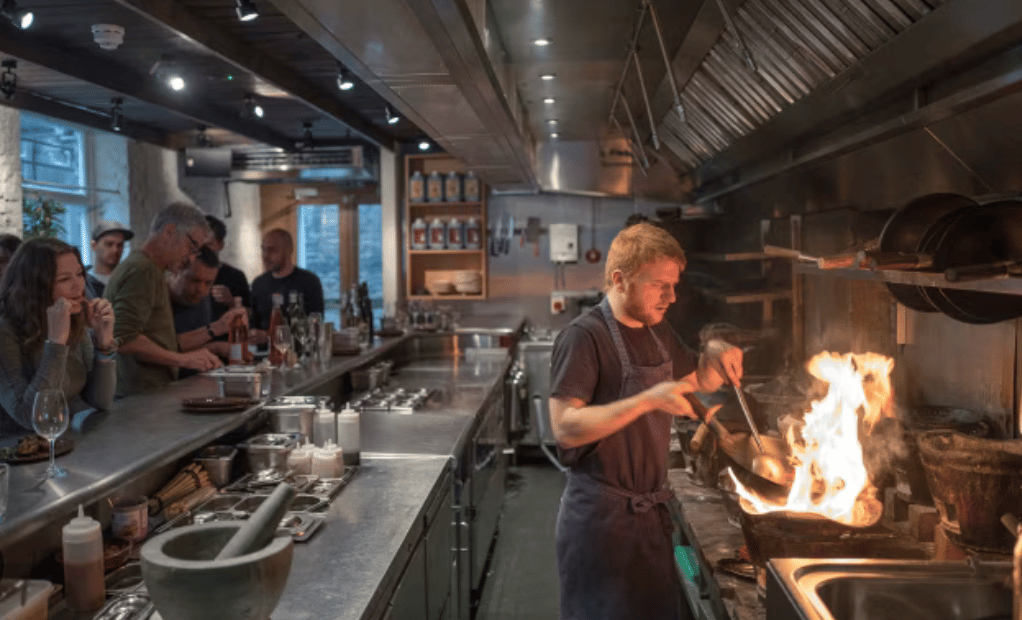
Dining at Kiln is an encounter with both smoke and patience: dishes arrive one by one, each coaxed into being over embers from local wood. There’s no soft marble here—just metal, brick, and the crackle of fuel.

Kiln’s food carries the soul of rural Thailand rather than Bangkok gloss. The clay pot glass noodles with Tamworth pork belly embody the restaurant’s core belief in texture, smoke, and the natural umami of slow cooking. The wild ginger and short rib curry hits deep bass notes of spice, funk, and fat—comfort food if your comfort zone involves chili and bone marrow.
The grilled aged lamb skewers remind you of what charcoal can do to meat; the mussel and sour turmeric curry evokes tropical brine and citrus brightness. The kitchen’s daily rhythm depends on sensitive sourcing—rare-breed meats, day-boat seafood, and fresh curry pastes made onsite. There are no extravagances, only purpose.
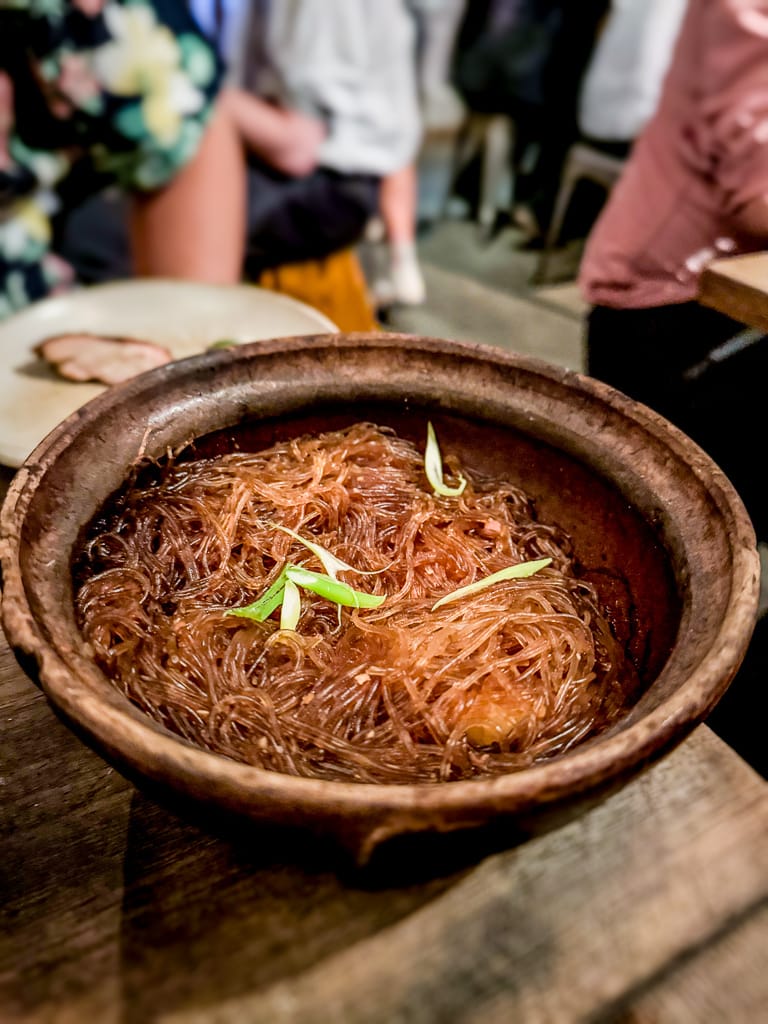
The space holds a brevity that amplifies its theatre. Counter seating places you practically inside the smoke—close enough to feel the ember heat, smell coriander root and chili as they toast in mortar.
Service matches the energy; staff speak quickly but clearly, translating flavors that might otherwise intimidate. They may describe how lime leaf cuts through fermented shrimp paste or why the curry fire builds rather than burns. You leave with your palate alive, your shirt carrying the scent of the open fire. A meal here typically lands around £30–£45 per head, a mark of value in Central London when you realize how much technique underlies every clay pot.

Kiln has built its legend on atmosphere as much as flavor. At the counter, singles eat shoulder to shoulder, passing napkins and sharing grins as dishes arrive from the flames. Conversation comes easy, perhaps a question about the curry paste, a comparison of spice levels, or a brief pause when a new aroma passes through. The room hums, music low, fire high. That intensity earned Kiln the National Restaurant Awards’ #1 spot in 2018, and years later it still feels fresh: unpolished but deliberate, elemental yet controlled. Chapman’s philosophy, to source locally, cook minimally, and let fire lead, still defines its gravitational pull.
The Verdict
Barrafina Dean Street and Kiln mark the two ends of Soho’s counter-culture spectrum. Barrafina distills Spanish precision, luxury, and grace; Kiln answers with Thai dynamism, smoke, and soul.
Placed side by side, Barrafina and Kiln could not sound more opposite, yet they express a shared ethos: immediacy, honesty, and the joy of visible craft. Barrafina’s counter reveals technical precision; Kiln’s, raw instinct and smoke. At Barrafina, your cava may chill beside the chef’s chopping board; at Kiln, your plate might arrive straight from the clay pot still hissing. In an age of tasting menus and exclusivity, this proximity feels liberating. One celebrates the Mediterranean palette of clean, sunny precision; the other thrives in layered spice, fermentation, and flame.
Encounters: Giacometti x Mona Hatoum
A meeting of two singular artistic minds animates the Barbican this season. ‘Encounters: Giacometti x Mona Hatoum’ gathers the haunting fragility of Alberto Giacometti’s figures with the charged, political intimacy of Mona Hatoum’s installations.
The exhibition, running at the Barbican Centre, explores how both artists probe the human condition—its endurance, its vulnerability, and its uneasy relationship with the spaces around it.

Visitors move through sculptural dialogues where distance and proximity become emotional measures rather than physical ones. Across the light-filled galleries, Hatoum’s wire cages and precarious domestic relics appear beside Giacometti’s elongated bronze bodies. Neither artist overwhelms the other; instead, their works converse quietly in material and mood.

Giacometti’s work is similarly confrontational. Visitors will immediately encounter his 1932 work, Woman With Her Throat Cut, a disquieting tone amplified by other sculptures: skeletal figures, cages, ruined furniture and a cell-like room.
The pair’s interest in how trauma manifests in the body culminates in a final group of works visualising the long half-life of war.
Giacometti’s attenuated forms, shaped in the aftermath of war, confront Hatoum’s minimalist reconfigurations of everyday objects. In placing them together, the exhibition converts recognition into estrangement. A table bristles with spikes; a figure seems almost to dissolve into air. Both gestures remind us how survival can feel delicate even in stillness.

The Barbican’s curatorial approach accentuates this sense of disquiet. Rooms open like thresholds, each one rewriting how the body relates to sculpture. Hatoum’s use of materials: stainless steel, light, and the repetition of domestic scale, melds with Giacometti’s pitted plaster textures. Viewers find themselves traversing between interior and exterior sensations, uncertain whether they are looking at sculptures or inside them.

It is not a show to pass through quickly. It asks you to inhabit the pause between closeness and withdrawal. This encounter also reframes both artists historically. Giacometti’s existential search for presence feels newly political when seen beside Hatoum’s cosmopolitan reflections on displacement and borders. Conversely, Hatoum’s installations gain a temporal echo, as if the postwar anxiety that haunted Giacometti persists in today’s fractured globalism. The pairing proposes that fragility is not only sculptural but social; that the human form remains a measure of instability across time.

The Barbican has built a reputation for dialogues that unsettle hierarchies of modern and contemporary. Staging Hatoum with Giacometti bridges a century of upheaval while resisting a simple lineage of influence. It reminds spectators that endurance, whether of material, identity, or art itself, is always provisional. In a moment when public space feels both contested and precarious, their shared language of scale and solitude gains urgency. The exhibition reads like a reflection on what remains humane when forms are stripped to essence.

Located within the Barbican Art Gallery, tickets are available through the Barbican’s official site, with timed entry slots encouraging an unhurried experience. For students of sculpture, lovers of conceptual art, or anyone attuned to the poetics of tension, it offers more than a retrospective. It is a conversation across decades that reshapes how we stand, look, and feel in relation to the art—and the world—it reflects.
Daily News for Curious Minds
Be the smartest person in the room by reading 1440! Dive into 1440, where 4 million Americans find their daily, fact-based news fix. We navigate through 100+ sources to deliver a comprehensive roundup from every corner of the internet – politics, global events, business, and culture, all in a quick, 5-minute newsletter. It's completely free and devoid of bias or political influence, ensuring you get the facts straight. Subscribe to 1440 today.
Sou Fujimoto: Futures of the Future
Sou Fujimoto likes to ask questions through his buildings.
How should we live now? How might we live tomorrow? The Japanese architect, celebrated for his “primitive future” philosophy, approaches design as an experiment in how humans relate to space. His vision stretches beyond modern minimalism; instead of smoothing over the mess of daily life, he lets it happen, composing structures that grow around us like clearings in a forest. Each work becomes an open proposal rather than a fixed solution.

Sou Fujimoto
That idea, “primitive future,” sounds paradoxical—primitive and futuristic in one breath—but it captures Fujimoto’s belief that architecture should connect deeply to our instincts. He often traces this back to natural forms such as caves or forests, places that allow people to adapt and discover their own ways of being.
His Final Wooden House in Kumamoto exemplifies this: stacked beams of solid cedar create a single volume where steps, shelves, and beds are whatever you decide they are. There are no doors, no clear boundaries, only surfaces waiting to be inhabited. The structure feels at once ancient and startlingly new.

Final Wooden House Japan
Look closer and the same spirit runs through his 2013 Serpentine Pavilion in London. Its cloud-like mesh of white steel offers shade and transparency all at once, hovering between architecture and sculpture. Visitors stepped inside to find that they had also stepped outside; light filtered through every angle, dissolving the walls in air. Fujimoto said he wanted to provoke a question: where does architecture end and nature begin? The answer, it seems, is that they never really separate.

Serpentine Pavillion London
House NA in Tokyo crystallizes that idea with a transparent lattice of floors and stairs that resemble a three-dimensional grid. Residents move from level to level as though climbing branches, each finding their own perch. Privacy and openness coexist strangely, yet naturally. The design resists the rigid lines of conventional living, honoring instead the fluid choreography of human behaviour. His work in public spaces expands those ideas on a monumental scale.

House NA Tokyo
In Montpellier, his L’Arbre Blanc rises like an inhabitable tree with cantilevered balconies that branch into the sky. For Expo 2025 in Osaka, he is designing the Grand Ring, set to become the world’s largest wooden structure. The project fuses sustainability and spectacle: a technological feat built from renewable material, reminding us that innovation does not have to sever its ties to nature.

L’Arbre Blanc Montpellier
Fujimoto’s future really is rooted in the primitive. There is a childlike openness in how he talks about architecture, which may come from his early life in Hokkaido, exploring dense woods that still inform his sense of space. He was fascinated by Antonio Gaudí’s organic forms, yet he looks past ornament toward experience—the feeling of discovery that architecture can prompt.

House of Music Budapest
To watch Fujimoto at work is to witness optimism built into steel and timber. His structures suggest that the most advanced future might look a lot like the simplest past, where we re-learn to adapt, to choose, to wander. In Fujimoto’s world, architecture does not tell you how to live—it listens.
Which of Sou Fujimoto's creations is your favourite?Click and vote below: |
Spotlight on Hoi An, Vietnam
Eat
Order cao lau at Cao Lau Khong Gian Xanh, a bowl of chewy noodles, tender pork, and crisp herbs said to rely on well water found only in Hoi An’s old quarter. It’s the city’s signature dish, simple yet deeply local, best enjoyed beneath paper lanterns and soft evening air.

Explore
Step inside Precious Heritage Art Gallery Museum, photographer Réhahn’s stunning portrait archive of Vietnam’s ethnic cultures. Housed in a French colonial building, it blends art, anthropology, and storytelling, reminding visitors that Hoi An’s creative spirit stretches far beyond its ancient streets.

Unwind
Cross the river at dawn to An Hoi Island’s back alleys, where locals set up morning markets before the crowds arrive. Grab iced coffee from a roadside cart and watch the town wake—Hoi An’s quietest, most magical hour belongs to early risers.
Thank you for reading!
How would you rate todays edition of the newsletter? |
Buying Cannabis Online Is Now Legal, And Incredibly Convenient

Thanks to changing laws buying THC online is now 100% federally legal.
And when it comes to quality, reliability and ultimate convenience, Mood is leading the way…
Because, instead of memorizing confusing strain names – you simply choose how you want to feel: Creative, Social, Focused, Relaxed, Happy, Aroused, and more.