- The Culture Vulture
- Posts
- Tamila vs BiBi: Modern Indian Tasting Menu Face-Off
Tamila vs BiBi: Modern Indian Tasting Menu Face-Off
This issue: London’s Indian dining showdown meets Frieze Week’s most radiant exhibition, Bolivia’s surreal salt mirror, and Adriatic calm in Montenegro.

Shakira Taylor
October 30, 2025

In partnership with

Hey Culture Clubbies!
London never sleeps, but it certainly eats and this week we’re serving the city’s latest culinary rivalry on a silver platter. From BiBi’s polished Mayfair precision to Tamila’s canal-side Tamil fire, it’s a showdown of flavour and philosophy. Then, we dive into Flourish, Ronchini Gallery’s painterly celebration of rebirth; travel across continents to Bolivia’s mirror-flat desert; and unwind in Montenegro’s Adriatic quiet. Four stories, one mission: to feed curiosity across taste, art, nature, and travel.
In under 10 minutes we’ll cover:
Tamila vs BiBi: Modern Indian Tasting Menu Face-Off
Flourish: Gestural Abstractions in Bloom at Ronchini Gallery
Salar de Uyuni’s Mirror Effect: Nature’s Infinite Selfie
Spotlight on Montenegro: Adriatic Charm Without Crowds
Let’s get started.
Stop Buying Expensive Probiotics

What if it only took ONE CAPSULE of your favorite probiotics to start a nearly unlimited supply of gut-healthy bacteria?
And it was not only affordable, but easy to do in the convenience of your own kitchen?
Now YOU CAN with the #1 best-selling Ultimate Probiotic Yogurt Maker.
Join the millions who have stopped wasting money expensive probiotics and store-bought yogurt. These products are weak and ineffective.
Make up to 2 quarts of probiotic-rich yogurt using a single capsule of probiotics or spoonful of your favorite yogurt.
Just mix this "starter" with half-and-half dairy and set it in the Ultimate Probiotic Yogurt Maker to make the magic happen.
And it's so easy, a child can do it. The next day, you'll be enjoying your very own, rich and creamy probiotic yogurt.
Try the #1 Yogurt Maker in the USA today risk-free for just $71.95 with our LIFETIME WARRANTY.
Get Yours Today!
Not evaluated by the FDA. This product isn’t meant to diagnose, treat, or cure.
Tamila vs BiBi: Modern Indian Tasting Menu Face-Off
London has become a global blueprint for modern Indian dining, and the contrast between BiBi and Tamila captures everything about what makes it so exciting. They’re both tasting menu experiences, both anchored in Indian tradition, yet their philosophies couldn’t land further apart. Where BiBi gleams in Mayfair with precision cooking and softly lit luxury, Tamila hums beside the Hackney Wick canals with an open kitchen, chatter in the air, the smell of frying dosa batter and roasted spices drifting through the room.
Each expresses Indian cuisine not as nostalgia but as evolution. The result is a conversation between two Londons and two Indias, a quiet dialogue of refinement versus roar, fine service versus street-soul flavour.
BiBi: Refined Craft and Polished Modernity in Mayfair
At BiBi, chef-patron Chet Sharma leads with intellect, restraint, and memory. His background reads like a modern culinary manifesto: stints at The Ledbury, Moor Hall, and as development chef for JKS Restaurants before launching BiBi.
The restaurant sits snugly in Mayfair yet feels more experience than address. Everything hums with a deliberate calm: honeyed lighting, burnished textures of buffed wood and gleaming brass, the soft tempo of conversation beneath a ceiling that holds the energy steady. It’s intimate but not intimidating, elegant in a way that never pushes away warmth.

Sharma’s menus, named Kamal and Ranjana after his grandmothers, are stories told in sequences of seasonal British produce and Indian heritage. The dishes move from delicate to daring: Orkney scallop nimbu pani, where scallop sweetness collides with a citrus tang reminiscent of Indian lemonade; the much-lauded Naga beef pepper fry, dense with heat and perfume, delivering the fierce character of northeastern spice but with astonishing precision; and Sharmaji’s Lahori chicken, glazed, crisp, and tender, a tribute to familial generosity recast with the touch of a scientist-chef.

The procession is never static, what appears simple lands layered with quiet technique, like lentil papads arriving brittle yet whisper-thin from careful dehydration, or breads blistered just right to cradle spicy, buttery gravies.
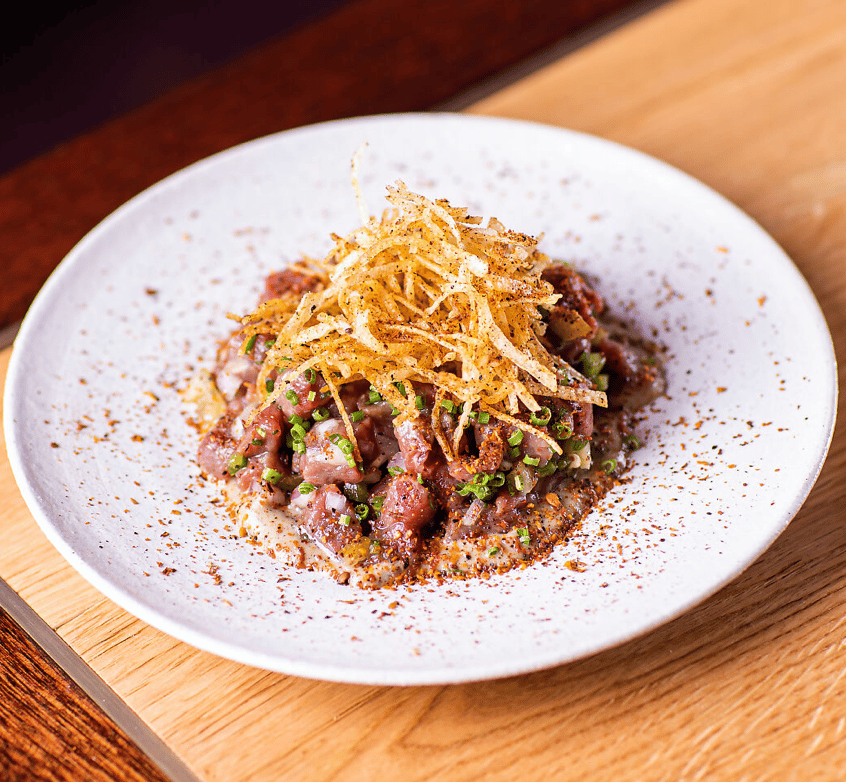
Dining here costs accordingly. Lunch set menus arrive in the £85 range, while the full Chef’s Selection tasting menus tilt toward £125 for dinner. It’s Mayfair pricing, but the trade-off is total immersion.
Each course arrives delivered by a team that operates with ballet-like precision: gliding service, crisp uniforms, seamless pacing. The staff narrates dishes with concise warmth rather than showmanship, reflecting Sharma’s scientific temperament: precise, clear, slightly understated. Guests leave feeling not overpowered by spice or spectacle but drawn into a memory made modern.
Awards have followed accordingly with GQ Restaurant of the Year, Squaremeal’s Best Restaurant in London, and a lasting position in the Michelin Guide’s upper ranks.

There’s also a sense of control threading through everything, right down to its beverage program. Pairings of wine and cocktails are choreographed against the spicing logic; acidity and aromatics align rather than dominate. You taste pepper with pepper, citrus with citrus, savoriness balanced by sweetness rather than masked by tannin. The result feels like engineering with every detail solved. If Mayfair has at times been accused of stuffy gastronomy, BiBi argues the opposite: that Indian food deserves luxury’s grammar without losing its language of warmth.
Tamila: Street-Soul Fire in Hackney Wick
Across the city in Hackney Wick, Tamila thrives on energy. Here, Indian food isn’t whispered but shouted across communal tables, where guests lean over plates and pass dosa edges crisped like lace. The setting reflects the canal-side creative pulse of the neighbourhood: open kitchen, peeling industrial textures, neon glow, and the sound of sizzling oil cutting through laughter. It’s immediate, unpretentious, grounded in Tamil roots but completely alive to the present moment.
Every detail of Tamila’s design feels like an argument against stiffness: large platters invite sharing, service leans on friendliness over flourish, and the food doesn’t hide behind concept, it bursts straight from tradition into the air.

Half of the concise menu is vegetarian, a rarity among tasting-driven restaurants, emphasizing veg-forward Tamil cookery as celebration, not compromise. One visit might bring pulled beef uttapam, the fermented rice pancake topped with shredded meat rich in tamarind; another, the crisp chicken lollipop coated in sticky chilli glaze that leaves heat curling at the back of your throat.
Masala dosa appears almost ritualistically, the potato filling perfumed with mustard seed and curry leaves, the dosa itself stretching across the plate like edible architecture. Every bite recalls street corners in Chennai, yet the context, a tasting-sequence format with clever pacing, lifts it beyond nostalgia into something curated without becoming precious.

If BiBi’s dinner can feel like theatre, Tamila feels like a gig. The chefs operate with open visibility, tossing spices, rolling dough, drawing guests into the immediacy of making. There’s music in the clang of ladles against skillets. The pricing strategy mirrors its ethos at £35–£55 per person, making it approachable, and locals often treat it as a social hangout as much as a culinary destination.
That accessibility doesn’t dilute quality; it creates a high–low glamour that’s uniquely London. Tamila’s chefs, though lesser known individually, collectively channel the home-cooked edge of Tamil kitchens. Critics highlight that it might lack the finesse of BiBi’s plating but more than compensates with sheer flavour power and generosity.

Drinks here lean into the festive: Indian beers sweating cold; cocktails built around tamarind, lime, and chilli; and a smaller wine list chosen to cut through richness. On busy nights the energy borders on euphoric, every table filled with groups sharing dosas, laughter carrying over the music. It’s hard to imagine stillness here, and that’s the point. The service moves briskly but without haste, keeping the atmosphere charged but human. Hackney Wick at night glows with reflected light on the canal, and Tamila folds into that fabric beautifully, it feels tied to its place in a way Mayfair never could.

Placing BiBi and Tamila side by side shows how far Indian cooking has evolved in London. At BiBi, precision and polish reveal how Indian flavors can speak fluent fine-dining language. At Tamila, looseness and laughter remind you that fine dining sometimes grows stiff when it forgets joy. They’re two expressions of affection rather than opposition: Sharma’s cerebral craft and Tamila’s sensory chaos orbit the same heart.
The Verdict
Choosing between BiBi and Tamila isn’t about better or best, it’s about what you crave from a meal. For celebrations, date nights, or those moments you want food to astonish through restraint, BiBi remains unmatched. Tamila, on the other hand, exists for nights when you want food to feel alive. When conversation should mix with spice in the air, when you want flavor that grabs your sleeve instead of bowing politely.
Together, they prove that Indian cuisine in London no longer has just one face. It’s neither curry-house comfort nor starched-table opulence; it’s both and beyond. Whether you’re nestled among Mayfair’s silks at BiBi or laughing through a storm of chili oil and sambhar at Tamila, you’re tasting the same evolution, the confidence of India’s kitchens told in two dialects. Refined or raucous, both speak beautifully fluent London.
Flourish: Gestural Abstractions in Bloom at Ronchini Gallery
There is an unmistakable charge in London’s air each October, when Frieze Week pulls collectors, critics, and the creatively curious into Mayfair’s orbit. This year, one of the most talked-about openings arrives at Ronchini Gallery’s new address on Conduit Street. The exhibition, Flourish: Gestural Abstractions in Bloom (16 October–12 December 2025), marks both a fresh chapter for the gallery and a celebration of four women artists whose work transforms the language of abstraction into something organic, urgent, and lush. It is free to visit, but the experience feels priceless: a quiet room where painting breathes again.

The show is curated as a dialogue between gesture and growth, essentially inviting visitors to stand among ideas that bloom. Michele Fletcher, Connie Harrison, Shuang Jiang, and Shara Mays come from three continents, and their visual vocabularies embody a shared instinct toward transformation. Fletcher’s canvases have what she calls “intuitive beginnings,” marks that swell into compositions reminiscent of gardens half remembered or seasons shifting within a single stroke. Her energy is matched by Harrison’s richly worked surfaces, where oil and wax accumulate like sedimentary layers of time. Together, their techniques describe feeling as landscape, motion as nature.

Across the gallery, Shuang Jiang’s work grips the eye more viscerally. Her process-driven mark-making finds emotion in decay and renewal, binding themes of personal trauma to the regenerative pulse of the natural world. Against this intensity, Shara Mays offers another register—paintings that echo terrain, horizon, and atmosphere but loosen them into rhythmic fields of color. Each artist translates a different version of flourishing; taken together, they create a gathering of forces rather than a polite bouquet.

Ronchini Gallery’s new 950-square-foot home provides the ideal stage. The period townhouse setting, newly renovated and awash with natural light, fosters a serene intimacy that invites slow looking. Exposed beams and whitewashed walls frame the paintings without pretension. After relocating from Dering Street, the gallery seems reborn, aligning this inaugural show with its architectural rebirth.

Timed with Frieze Week, the exhibition already hums with critical attention. Critics have noted how its emphasis on women’s perspectives contributes to a larger shift within contemporary abstraction. Instead of heroic gestures, we see emotional intelligence rendered through material experimentation. Paint, wax, and canvas become metaphors for tending, layering, and healing: acts of making that resonate beyond the art world’s seasonal calendar.

Why go now? Because Flourish demonstrates how abstraction, often misread as detached or cerebral, can feel earthy, embodied, and alive. In Ronchini Gallery’s light-filled rooms, the works seem to pulse with the same logic that governs gardens - cycles of bloom, loss, and renewal. To stand before these paintings is to feel something quietly expand outward, reminding you that growth is rarely neat but always necessary.

What: Flourish: Gestural Abstractions in Bloom
Where: Ronchini Gallery, 21 Conduit Street, Mayfair, London W1S
When: 16 October–12 December 2025 Admission: Free entry, details at ronchinigallery.com
Daily News for Curious Minds
Be the smartest person in the room by reading 1440! Dive into 1440, where 4 million Americans find their daily, fact-based news fix. We navigate through 100+ sources to deliver a comprehensive roundup from every corner of the internet – politics, global events, business, and culture, all in a quick, 5-minute newsletter. It's completely free and devoid of bias or political influence, ensuring you get the facts straight. Subscribe to 1440 today.
Salar de Uyuni’s Mirror Effect: Nature’s Infinite Selfie
At nearly 11,000 square kilometers, Bolivia’s Salar de Uyuni is vast enough to be seen from space, yet it is a few centimeters of water that turn it into the world’s largest natural mirror. When the rainy season arrives, the flattest place on Earth becomes a stage for illusion. A thin film of rainfall rests perfectly atop a crust of blinding white salt, and suddenly the horizon disappears. Sky and ground fold into each other until it feels as though you are walking through air itself.

The transformation happens between late January and early March, when rainwater lingers just long enough to coat the flats before evaporating under the high-altitude sun. In these weeks, every cloud and wisp of color doubles, forming a seamless reflection that tricks the senses. Visitors watch themselves float in duplicate, the experience as dizzying as it is calm. What appears infinite is, in truth, only millimetres deep.

Unlike a lake or lagoon, the mirror is not perfectly uniform. Subtle variations in depth and mineral crust change the reflection’s sharpness in different spots, which is why each visit renders a unique version of the same dreamscape. Look closer: satellite measurements and field surveys reveal that even a slight change in rainfall can shift the clarity, turning crisp reflections hazy in one patch and glasslike in another.

One of the finer curiosities is that wind rarely disturbs the surface. The water layer is too thin for proper waves to form, so even in a breeze the illusion holds steady. This stability draws photographers from around the world chasing the perfect “perspective pic.” With no horizon to anchor the eye, scale collapses. A person can appear to fit in the palm of a hand or stand atop their friend’s shoulder with ease. The mirror flattens depth so completely that reality becomes a playful optical game.

Beneath the surface lies a different story altogether. The salt crust that enables this spectacle holds nearly seventy percent of the planet’s lithium reserves. Beautiful yet industrially charged, Salar de Uyuni represents both fragile wonder and essential resource. Its mirror is temporary, but its significance runs deep, bridging nature’s artistry and science’s necessity. Whether one visits at dawn, dusk, or under a blanket of stars, the salt mirror invites a single quiet act: look, then look again, until reflection itself becomes infinite.
Spotlight on Hoi An, Vietnam
Eat
Begin your day at Nishiki Market, Kyoto’s century-old “Kitchen of Japan.” Wander through narrow alleys lined with stalls selling sizzling yakitori, freshly made yuba (tofu skin), and fragrant pickles unique to the region.

Explore
Step into Kyoto’s Contemporary Art Museum (Kyocera Museum of Art) in Okazaki Park. Rotating shows by modern Japanese painters, sculptors, and international artists. The museum’s garden terrace overlooks Mount Daimonji, blending art and landscape in perfect harmony.

Unwind
Rise before dawn and visit Fushimi Inari Shrine before the crowds. The famous orange torii gates glow softly in morning mist, and the mountain trail feels almost private.
Thank you for reading!
How would you rate todays edition of the newsletter? |
Buying Cannabis Online Is Now Legal, And Incredibly Convenient

Thanks to changing laws buying THC online is now 100% federally legal.
And when it comes to quality, reliability and ultimate convenience, Mood is leading the way…
Because, instead of memorizing confusing strain names – you simply choose how you want to feel: Creative, Social, Focused, Relaxed, Happy, Aroused, and more.