- The Culture Vulture
- Posts
- Marjorie’s: Soho’s Wine-Bar That Actually Cooks
Marjorie’s: Soho’s Wine-Bar That Actually Cooks
This issue: French-inspired dishes and wine; an upcoming global photography show at Tate Modern, a bold, sustainable museum rises in Abu Dhabi; plus a unique travel spotlight.

Shakira Taylor
December 01, 2025

In partnership with

Hey Culture Clubbies!
This week we slip into the candle-lit world of Marjorie’s — a “wine-bar” that quietly turned into one of Soho’s most exciting new food spots. Expect French-style small plates, clever cooking, and a vibe that feels both intimate and electric. After that, we’re branching out: dipping into art and design picks, and sending you somewhere far outside London’s bustle for a little wanderlust.
In under 10 minutes we’ll cover:
Marjories — can a wine bar actually do good food?
Light and Magic: The Birth of Art Photography
Zayed National Museum
Spotlight on: Socotra, Yemen
Let’s get started.
Save 30% for Black Friday at Medik8!

Black Friday is here, but these skin care deals won’t last long! Rediscover your skin's youthful glow with Medik8, the British clinical skincare brand, delivering results without compromise. There is no better time to shop Medik8’s best-selling, results driven skincare at 30% off!*
*Terms & Conditions Apply
Marjorie’s: Soho’s Wine-Bar That Actually Cooks
When the new duo Michael Searle and Josh Anderson announced they were opening a Paris-inspired “bar à vins” in Soho, sceptics numbered many, a wine bar so close to Carnaby Street could easily lean tacky, loud, or gimmicky. But walking down Foubert’s Place and entering Marjorie’s, that cynicism evaporates. Instead, you step into one of the more quietly compelling restaurant openings London’s seen in 2025.
Marjorie’s
The venue occupies a two-level space at 26 Foubert’s Place: a travertine-topped communal bar on the ground floor for casual wine, cheese and charcuterie, and a cozy basement dining room with an open kitchen for diners wanting real food. The aim to bring a “missing slice of Paris” to Soho. The idea is simple: offer the relaxed conviviality of a French wine bar: a glass poured, friends gathered, low lighting, easy conversation but with a kitchen capable of unexpected, thoughtful, and often adventurous plates.
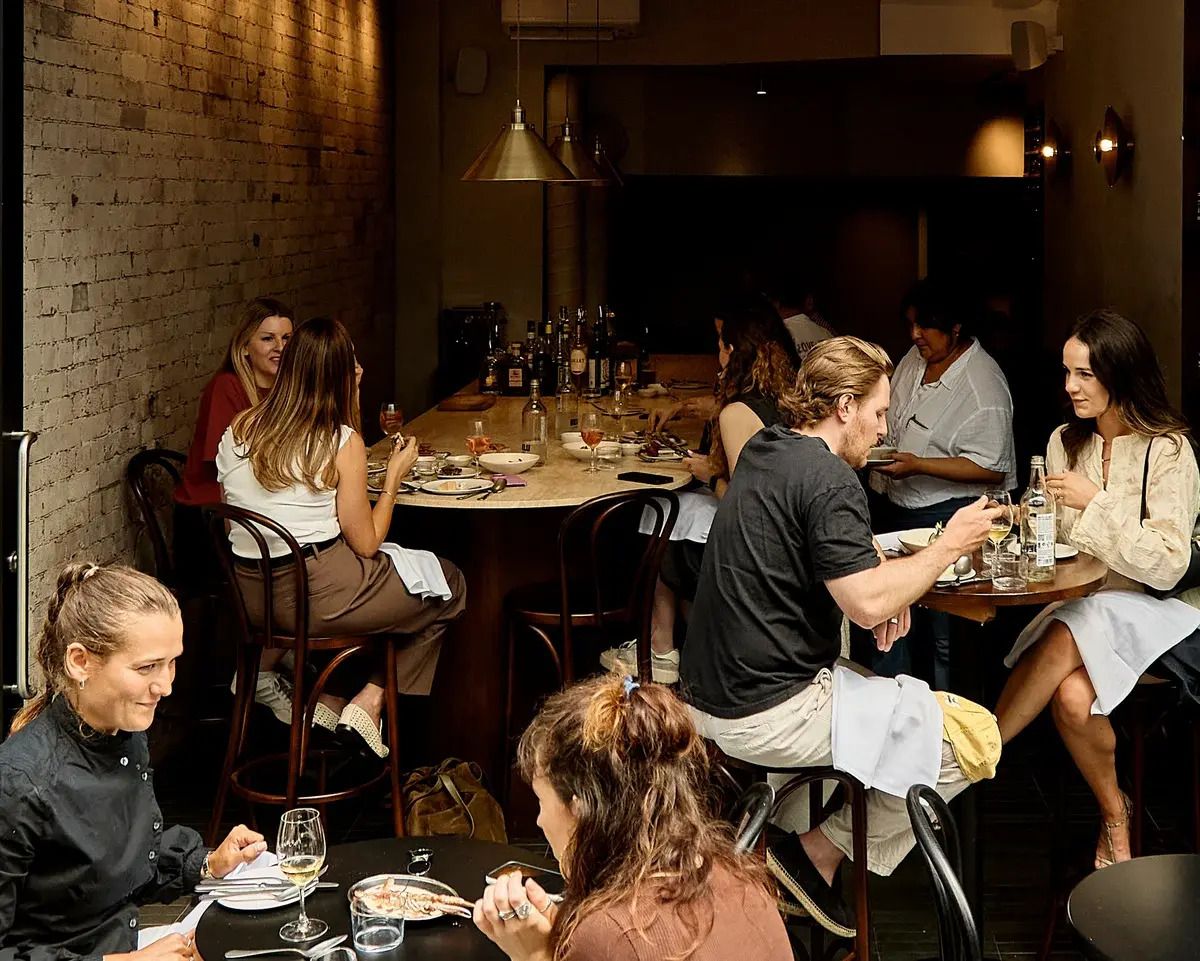
Some of the kitchen’s hits feel strikingly confident in flavour and character. The escargots bathed in pine-nut cream and seaweed, or the fried courgette batons topped with trout roe and rouille, carry the kind of risk-taking that many “wine bars” shy away from. The bravery shows. The décor — low lights, brick walls, a compact dining room — might suggest something hushed and modest; instead, the food is bold and curious. The cheeseboards and simpler wine-bar options are always there if you want to play safe. But if you let the kitchen lead and sample some of the more adventurous plates, Marjorie’s reveals itself as a space where creativity and taste walk together comfortably.

Diners can start with something playful, a “chicken-liver rocher” rolled in hazelnut crumbs (savory, nutty, deeply rich) or a bright crab tartlette elevated by kumquat, then move on to dishes like wild courgette batons fried crisp and topped with trout roe and rouille, or escargots in a seaweed-and-pine-cream playing mix of brine and forest.

When the kitchen leans heavier, you get plates like bavette steak topped with an egg-yolk emulsion and girolles, a nod to French technique made for sharing, or poached chicken with brown-butter rice, modest but honest comfort food that fits the bar’s vibe. Desserts aren’t afterthoughts either: a high-stacked mille-feuille layered with custard and seasonal fruit draws enough praise to end the night on a high note.

Well how about the wine…
The wine list matches the kitchen’s taste: short, French, focused on small or thoughtful producers, with glasses by the way (not just bottles) — perfect for a solo drink, a date, or a friends’ night without overthinking it. The ambience hits a sweet spot too: upstairs, a convivial travertine-topped bar for chat and drinks; downstairs, the dimly lit open kitchen room offering intimacy and a front-row view of the cooking.
Feedback from early diners echoes the strong reviews. Many call it “a gem,” praising the food, the wine list and the atmosphere — especially for nights out, spontaneous dinners or small celebrations.

It’s not flawless: space is tight, and upstairs can feel buzzy and loud (not surprising given its Soho strip-side location), and larger mains don’t always hit their mark, according to some reviewers. Still, for what it aims to be, Marjorie’s delivers more than expected: a wine-bar that doesn’t settle for half-measures, but shoots for genuine cooking, warmth and surprise.

It’s the kind of place where the line between “wine-bar nibbles” and “proper restaurant plates” gets blurred and often in the best possible way. Upstairs, the travertine bar hums with casual chatter and clinking glasses, a perfect pre-theatre drop-in or last-call hang-out. Downstairs, though, the basement kitchen transforms that casual vibe. The contrast between relaxed bar above and serious cooking below is part of Marjorie’s charm. It gives the place a kind of dual personality: one for sipping and socialising, another for tasting and thinking.

The Verdict
Marjorie’s doesn’t pretend to be a grand restaurant, and it doesn’t need to. It’s a wine bar that redefines what we expect from wine bars — thoughtful, inventive cooking; an atmosphere that balances intimacy with energy; and a menu that invites return visits rather than one-off spectacles. If you crave food with subtle audacity, wine with genuine character, and a dinner that feels uncensored but not unruly — head to Foubert’s Place, order the liver rocher with a glass of pinot gris, and let Marjorie’s surprise you.
Light and Magic: The Birth of Art Photography
To step into Light and Magic: The Birth of Art Photography at Tate Modern is to see the medium reborn before your eyes.
Opening on 8 October 2026 and running through 14 February 2027, this landmark exhibition traces the rise of pictorialism—the first global art photography movement—from the 1880s to the 1960s. It is an ambitious and deeply researched presentation of over fifty artists from across continents, transforming photography’s story from a Eurocentric timeline into a rich, international dialogue. Visitors move from Shanghai to Sydney, New York to Cape Town, and São Paulo to Singapore, all within the walls of London’s revered turbine halls.

Tate Modern
The title Light and Magic captures both the technical mastery and poetic sensitivity at photography’s core. The curators have gathered never-before-seen works alongside treasures from Tate’s own collection to create a conversation across generations and geographies. These images, brought together for the first time, reveal photography’s restless experimentation long before the digital age. The exhibition reframes a familiar history, showing how early photographers around the world were already pushing against the conventions that defined painting and sculpture.

The sheer scale of international representation distinguishes this show. As Tate Modern notes, its scope extends well beyond Western modernism. Artists from Brazil and Singapore appear beside contemporaries in Paris or London, revealing how different cultures shaped a shared visual ambition: to prove that photography could rival fine art. The results are lush, analog visions where light is handled like pigment, and shadow carries emotional weight. Displayed in intimate sequences, the works seem to breathe in rhythm with the changing global light that inspired them.

Luo Bonian - early 1900 photographer
By gathering works spanning nearly eighty years, Light and Magic invites visitors to understand photography not as documentation but as expression. The pictorialists blurred lenses, softened focus, and manipulated printing techniques to make images that felt closer to painting or poetry. Each print holds the moment when photography first realized its artistic potential. The show’s chronological spread reveals how that innovation rippled outward, influencing movements from Surrealism to modern abstraction. The curators’ decision to include overlooked voices adds an inclusive layer, showing how creativity sparked simultaneously across borders.

This exhibition also resonates with today’s renewed fascination for analog process. In a digital culture defined by instant imagery, the patient craft of early photographers feels radical once again. Visitors will recognize the roots of contemporary art photography in these atmospheric studies of light and form. The exhibition’s global narrative celebrates experimentation across continents and reminds us that artistry often comes from those working on the periphery as much as from the canonical centres.

The experience is accessible too: admission is free for Tate Members, while visitors aged sixteen to twenty-five can explore it through the Tate Collective scheme for £5 tickets.
Turn AI Into Your Income Stream

The AI economy is booming, and smart entrepreneurs are already profiting. Subscribe to Mindstream and get instant access to 200+ proven strategies to monetize AI tools like ChatGPT, Midjourney, and more. From content creation to automation services, discover actionable ways to build your AI-powered income. No coding required, just practical strategies that work.
Foster + Partners’ Zayed National Museum: Why Abu Dhabi’s Cultural District Is Reshaping Global Architecture
When it opens in December 2025, the Zayed National Museum will stand as both a monument to the UAE’s founding father and a case study in how architecture can embody national identity. Designed by Foster + Partners, the 44,000‑square‑meter structure rises from Saadiyat Island like a sculpted mound of desert sand punctured by five gleaming steel towers that mimic falcon wings mid‑flight. Each wing is more than a metaphor. They function as thermal chimneys, channeling hot air upwards to draw cooler air through the shaded galleries below. The result is a building that breathes, a museum where sustainability and symbolism share the same pulse.

The five wings, polished to metallic precision, set the tone for a district determined to redefine cultural aspiration through architecture. Saadiyat Island already houses the Louvre Abu Dhabi and the newly opened Abrahamic Family House, with Guggenheim Abu Dhabi and a TeamLab complex still in progress. The Zayed National Museum joins them as the institutional anchor, dedicated to Sheikh Zayed bin Sultan Al Nahyan’s vision of unity, environment, and progress. Its very shape reads as a timeline of that vision: a terrestrial mound that appears to rise naturally from the coastline, a synthesis of landscape and nationhood.

Inside, six permanent galleries trace 300,000 years of regional history across two levels. Artifacts like the luminous Blue Qur’an speak to Islamic artistry, while the Abu Dhabi Pearl recalls the emirate’s pre‑oil economy, linking modern prosperity to the fragile origins of its heritage. Each gallery has been designed as a suspended “pod” within the central atrium, so visitors navigate through history as if floating over an illuminated void. It is a theatrical experience, closer to choreography than exhibition design. The play of light from the top-lit lobby constantly shifts, connecting the visitor to the cycles of daylight just outside the mound.

Inside
Look closer and the building’s storytelling continues in its landscaped gardens. A path designed as a timeline of Sheikh Zayed’s life extends toward the sea, rooting biography in geography. This garden sequence leads visitors through milestones of environmental reform and nation building, showing how external form and narrative content are intertwined. Foster + Partners’ design rejects the once‑planned idea of a literal green roof in favor of this sculptural mound. The change signals a broader evolution in museum architecture: away from applied sustainability features toward buildings that internalize climate as concept.

The museum’s innovation is as much technical as symbolic. Its passive cooling system integrates with local climatic wisdom, translating the desert’s natural ventilation into twenty‑first‑century performance. In collaboration with Zayed University and NYU Abu Dhabi, the museum also hosts the reconstruction of an ancient Magan Boat, the first major research partnership of its kind between Emirati and international institutions. It becomes clear that the Zayed National Museum is conceived as more than a spectacular shell. It is an operational narrative about exchange and continuity.

Saadiyat Island itself tells another story if you read its timeline. The district’s rollout—Louvre in 2017, Abrahamic Family House in 2023, Zayed National Museum next, with Guggenheim and TeamLab still to come—reveals an intentional layering of global art, interfaith dialogue, and national storytelling. Each opening adjusts the island’s cultural gravity, shifting Abu Dhabi’s identity from emerging patron to architectural curator of global culture. The Zayed National Museum is the keystone that binds these aims to an authentic local source.
In this district, spectacle becomes infrastructure and sustainability becomes heritage. The falcon-wing towers are not just photogenic spires but working lungs, proving that symbolic form and environmental function can coexist without compromise. The larger question now belongs to visitors and architects alike: should the museums of tomorrow prioritize architectural spectacle or invisible sustainability?
Spotlight on Socotra, Yemen
Eat
Begin your adventure through Socotra's otherworldly scenery with a sampling of Local Socotri Cuisine. Meals here tell a story of sea winds and spice routes, where grilled fish meets fragrant rice, coconut milk, and fresh herbs gathered along the coast. The recipes reflect centuries of maritime exchange connecting Arabia, Africa, and South Asia.

Diksam plateau - Dragon’s blood trees
Explore
The island’s beating heart lies on the Diksam Plateau, where the strange silhouettes of Dragon’s Blood Trees dominate the horizon. Their umbrella-shaped canopies stand like natural sculptures over deep canyons that seem carved by another planet’s hand. Hike or drive across this plateau to witness the famous red resin historically prized as a medicine and dye.

Wadi Dirhur Canyon
Unwind
When adventure calls for calm, descend into Wadi Dirhur Canyon, a secluded oasis far from Socotra’s salt air. Here the rock walls glow amber, framing crystal pools that invite you to swim or simply float in stillness.
With nearly 700 species found nowhere else on Earth, Socotra remains one of the planet’s last untamed frontiers—a World Heritage treasure for travelers drawn to the extraordinary.
Thank you for reading!
How would you rate todays edition of the newsletter? |
Sticking with the same home insurance could cost you
Home insurance costs are rising fast, up nearly 40% nationwide in just the past few years. With premiums changing constantly, sticking with the same provider could mean overpaying by hundreds of dollars. Shopping around and comparing multiple insurers can help lock in better rates without losing the protection your home needs. Check out Money’s home insurance tool to shop around and see if you can save.