- The Culture Vulture
- Posts
- Victoria Face-Off: Shan Shui Social vs Hanbaagaasuuteeki
Victoria Face-Off: Shan Shui Social vs Hanbaagaasuuteeki
Shan Shui Social’s dim sum, roasts, and Shanghai-style polish versus Hanbaagaasuuteeki’s Asian-twist burgers, fast energy, and cult appeal. Then we step into David Hockney at the Serpentine, unpack Tracey Emin’s Raw Confession Booth, and end in Antigua, Guatemala.

Shakira Taylor
March 10, 2026

In partnership with

Hey Culture Clubbies!
In this edition, we are heading to Victoria for a food face-off between two very different crowd-pleasers. On one side, Shan Shui Social brings Cantonese comfort, glossy roasts, dim sum finesse, and a room dressed in old-Shanghai glamour. On the other, Hanbaagaasuuteeki goes all in on burgers with an Asian twist, pairing kimchi heat, miso-laced sides, and punchy flavors with a bright, fast-moving, high-energy setting. One is built for cocktails, sharing plates, and lingering dinners. The other is built for big cravings, quick impact, and maximum flavor. Ready to pick your winner by mood, appetite, and budget.
Dim Sum Showdown: Shan Shui Social vs Hanbaagaasuuteeki
David Hockney: A Year in Normandie and Some Other Thoughts about Painting
Tracey Emin’s Raw Confession Booth
Spotlight on Antigua, Guatemala
Let’s get started.
The Daily Immune Ritual I Trust All Winter Long

Winter is when I’m most intentional about supporting my immune system, and Pique’s Daily Immune has become one of my non-negotiables. It’s the kind of daily ritual that feels supportive, not overwhelming and one I actually look forward to.
What sets Daily Immune apart is its liposomal vitamin C, which helps deliver nutrients more effectively to your bloodstream and immune cells, where they can truly do their job. I notice the difference in how steady and resilient I feel, especially during colder months when my body needs extra support. The addition of elderberry gives it that extra layer of seasonal immune defense I trust.
Daily Immune supports my everyday immunity, collagen production, skin resilience, and antioxidant protection all in one simple step. I love that it fits seamlessly into my routine and tastes bright and refreshing.
Winter wellness doesn’t need to be extreme to be effective. For me, Daily Immune is an easy, consistent way to feel supported, strong, and cared for all season long
Victoria is not usually sold as a place of culinary identity. It is sold as transit. Trains, offices, briefcases, pre-theatre timetables, people power-walking toward somewhere else. But on Buckingham Palace Road, two restaurants are trying to slow that machinery down in very different ways.
Shan Shui Social leans into 1920s Shanghai fantasy, with dim sum, roast meats, cocktails, and a room built for lingering. Hanbaagaasuuteeki goes the other way. It takes the humble burger, runs it through Korea, Thailand, Japan and China, then serves it fast, loud, and with enough swagger to open practically beside Bleecker and Shake Shack. One is silk, lacquer and steam. The other is potato buns, kimchi heat and red-splashed burger energy. Both are trying to win Victoria on flavour, but they are playing very different games.
Shan Shui Social: Shanghai Glamour, Cantonese Comfort
Shan Shui Social arrives with more theatre. Officially, it pitches itself as a 1920s Shanghai-inspired restaurant, pairing regional Chinese food with a playful, casual-dining sensibility. In practice, that means a polished but unfussy room, cocktails with lychee, calamansi and yuzu, and a menu that moves between Cantonese delicacy and Sichuan heat.
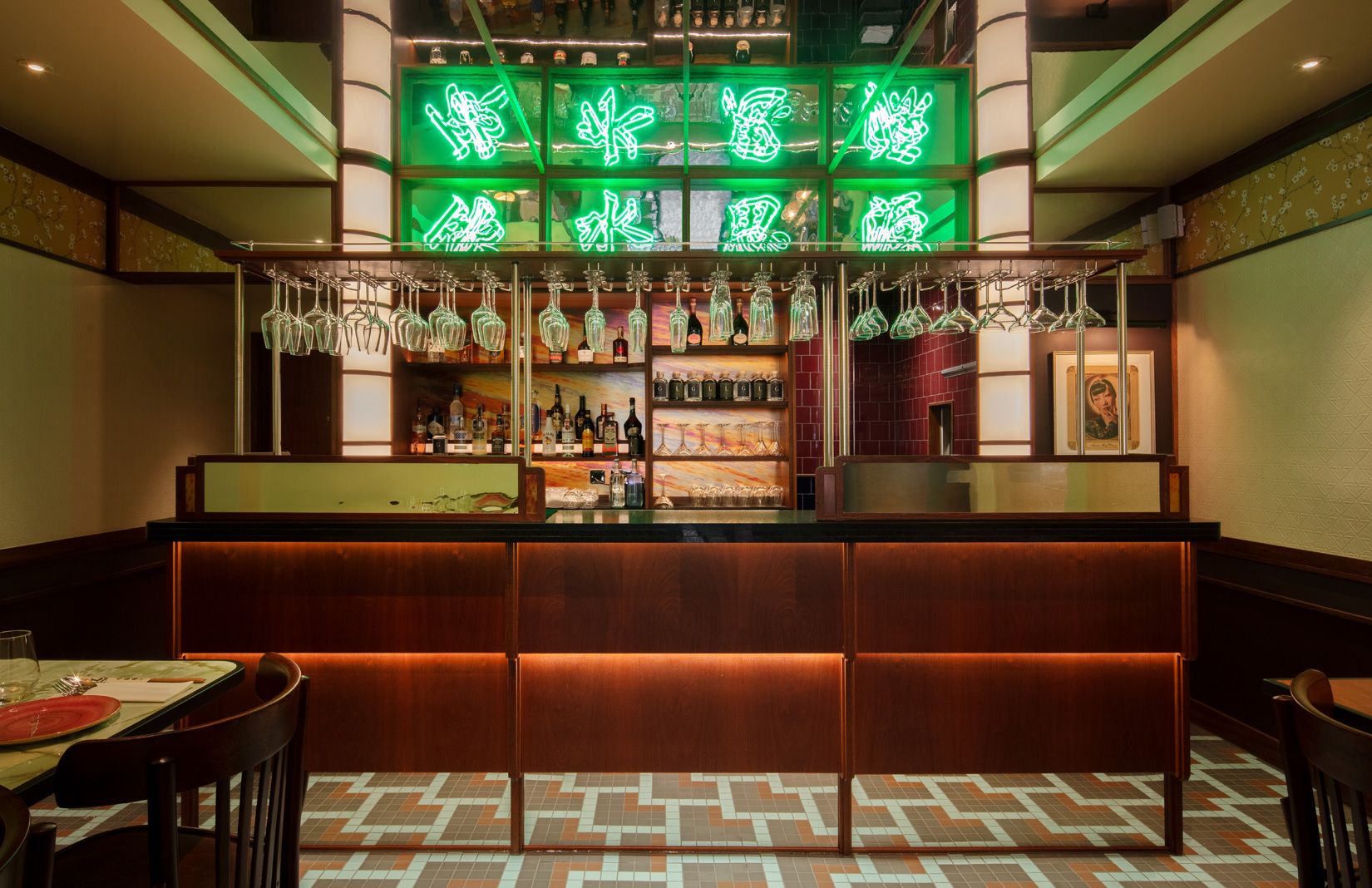
OpenTable places it in the £26 to £40 bracket and describes it as “Casual Elegant,” while SquareMeal notes one-plate lunch specials from around £14 to £16, plus a menu structured around dim sum, roasts, wok dishes, rice and noodles. It is not trying to be a hole-in-the-wall. It wants the date night, the team lunch, the pre-theatre booking, and the birthday table that still wants good dumplings.

The food is the reason to go, but also the reason the concept works. Shan Shui Social does not force you into one register. You can order gently, with shrimp and scallop dumplings and silky cheung fun, or you can push into richer, louder territory with salted egg prawns, mapo tofu, braised aubergine and soy-glazed Chilean sea bass. The point is range. This is a menu built for the table rather than the individual. Even its strongest reviews circle back to that mix of delicacy and abundance: authentic Cantonese flavour, roast meats, dim sum, cocktails, and enough variety to keep a group interested. It feels designed for social appetite rather than private obsession. A burger place asks what you want. Shan Shui asks what everyone wants, then makes sharing look elegant.

The atmosphere matters almost as much as the menu. Review summaries on OpenTable repeatedly describe the room as stylish, warm and lively, with a buzzy energy that suits celebrations and pre-theatre dinners, while SquareMeal frames it as “elegant yet relaxed.” The official site talks about sophistication wrapped in playfulness, and that feels accurate. This is not old-school Chinatown chaos, nor is it antiseptic luxury. It is mood-managed glamour. The sort of place where the lacquered meats and cocktails are part of the décor. The sort of place that wants you to feel slightly improved by having chosen it. Victoria needs restaurants like that, frankly, because too much of the area still eats like an apology.
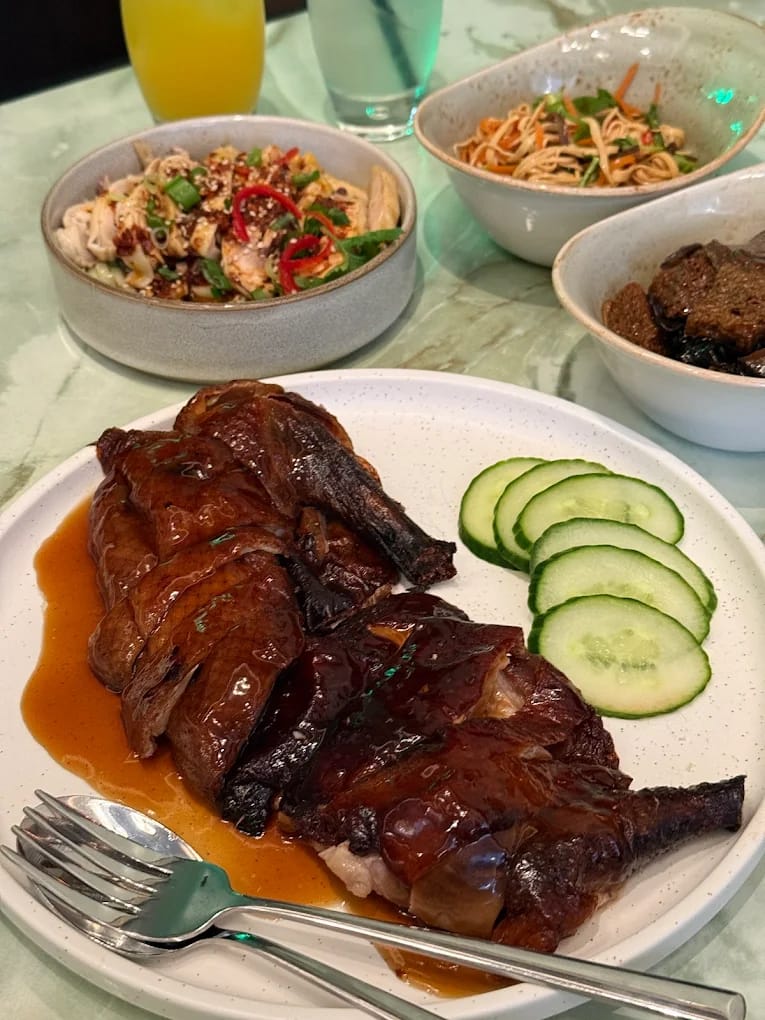
Service seems to follow the same brief. OpenTable’s review summary leans hard on “amazing food” and “outstanding service,” and TripAdvisor comments praise the lack of rushing, solid pacing, and good value alongside the central location. That pattern matters. Shan Shui Social is clearly chasing repeat custom from locals, office workers and theatre-goers, not just first-visit novelty. Restaurants built around atmosphere often wobble on service, because the room does too much of the talking. Shan Shui appears to understand that if you want people back for duck, dim sum and cocktails, the front-of-house cannot behave like it resents your existence. Radical stuff, I know.
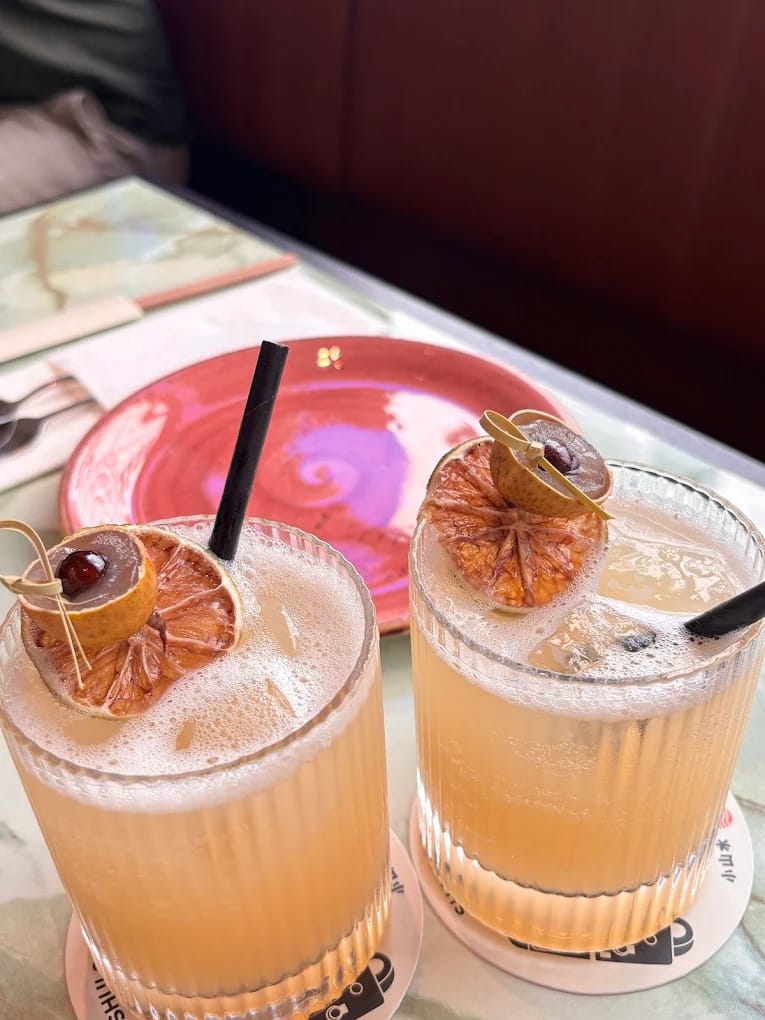
Hanbaagaasuuteeki: Burger Maximalism with a Pan-Asian Accent
Hanbaagaasuuteeki is much less interested in seduction. It is interested in impact. It opened in 2025 at 36 Buckingham Palace Road, in the thick of Victoria’s burger cluster, and has been described by Time Out as an “Asian-inspired burger joint” bold enough to plant itself within easy reach of Shake Shack and Bleecker. Hot Dinners says it launched with a tight menu of burgers riffing on Japan, Korea and Thailand, while later reviews show that the menu has expanded, with Time Out noting nine burgers and social posts regularly placing prices in the £9 to £14 range. Where Shan Shui’s luxury is layered and ambient, Hanbaagaasuuteeki’s appeal is immediate. You walk in because you want something messy, specific and a little deranged, in the best possible way.
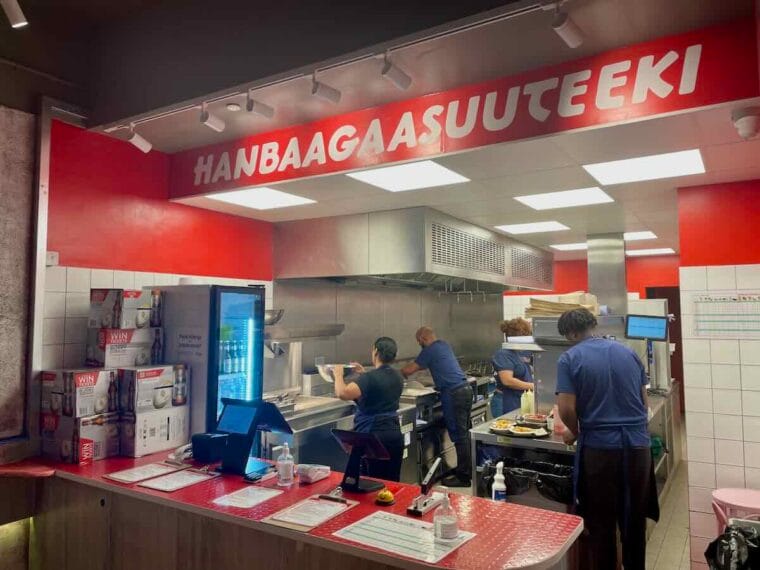
Its strongest suit is that the fusion does not sound like a boardroom accident. Time Out praises the more inventive burgers precisely because they do not feel like gimmicks, singling out the shrimp kong baga, a surf-and-turf number with crispy shrimp, smashed beef, cheese and tangy dressing, as the best thing on the menu. Other reviewers highlight the Szechuan chicken burger, miso fries, kimchi-loaded fries and kimchi burger, while Hot Dinners flagged the Isan burger and the off-menu Szechuan chicken sandwich early in the restaurant’s life. This is burger thinking with actual imagination behind it. Not “we added sriracha and called it Asia,” but a proper attempt to create distinct flavour identities across the menu. Sometimes that boldness tips into excess. Wrap Your Lips Around This found the Isan burger more heat than harmony. But even that criticism proves the point. Hanbaagaasuuteeki would rather overshoot than bore you.

The room is part of the charm, though in a completely different register from Shan Shui. Time Out describes high stools, counter-top tables and bright red splashes of colour, comparing it to In-N-Out with a K-pop twist. The Standard saw a blue, red and grey interior that looked almost 16-bit, while London Unattached describes a straightforward layout built around a large central table and bar-style seating, with none of the anonymous self-ordering screen nonsense. DesignMyNight similarly notes a central communal table and counter seating, with background music and a warm neighbourhood feel. That all points to the same thing. Hanbaagaasuuteeki is not a destination for hush or polish. It is a drop-in room with visual punch and just enough personality to keep fast food from feeling disposable.
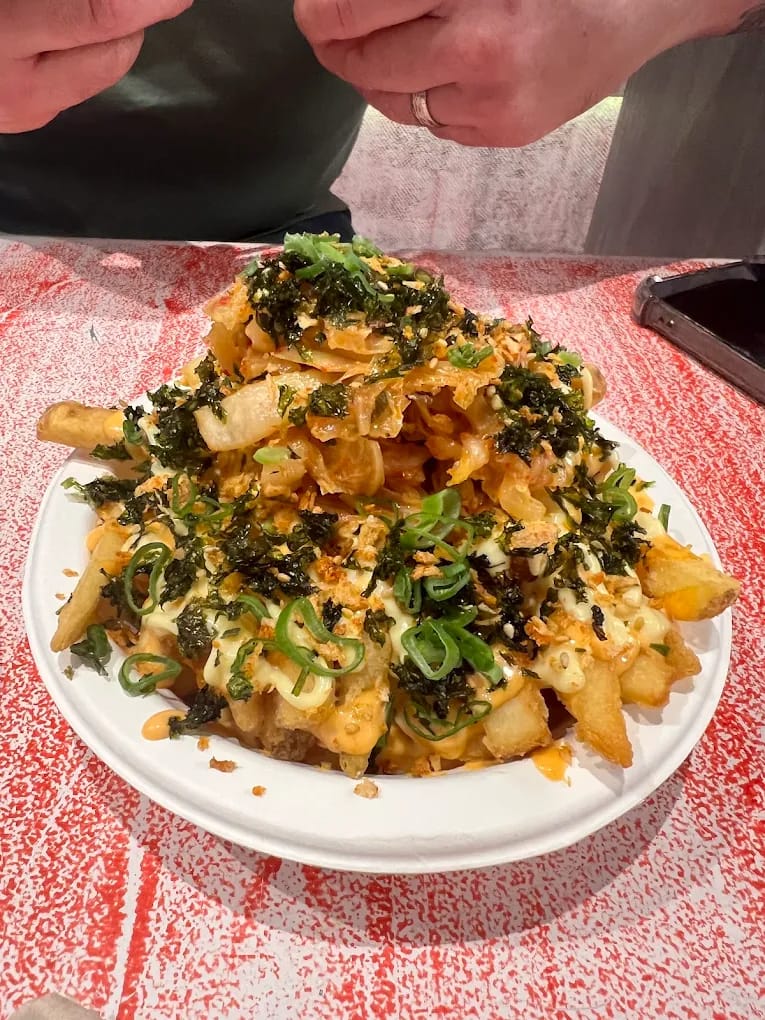
Loaded miso fries
Service appears to be one of the reasons the place has built real affection so quickly. London Unattached specifically praises manager Jackson for chatting with diners and guiding them through the menu, calling that kind of personable attention rare in fast food. Google review aggregations show a strong rating trend, and multiple review snippets mention quick, efficient service and unusually engaged staff. That matters because burger restaurants live or die by pace. Nobody wants to wait ages for smashed patties unless they are being forged by dwarves under a volcano. Hanbaagaasuuteeki seems to understand the rhythm. Quick enough for Victoria, friendly enough to feel human, and confident enough to talk you into the weird burger instead of the safe one.

The Verdict
Shan Shui Social is the more complete restaurant. It has the stronger sense of occasion, the richer atmosphere, the more versatile menu, and the sort of service that can carry lunch, dinner or drinks without changing costume. If you want Victoria to feel glamorous for two hours, this is the better bet.
Hanbaagaasuuteeki, though, may be the more exciting proposition. It takes a format London knows too well and jolts it awake with Korean, Thai, Japanese and Chinese influences, plus a room and service style that feel lively rather than templated. If Shan Shui is about settling in, Hanbaagaasuuteeki is about hitting hard.
Together they capture two very different futures for Victoria dining. One says sophistication still matters. The other says fun does too. Steam basket or smashed patty. Lychee cocktail or miso fries. Silk or sizzle. Victoria, improbably, now does both.
David Hockney: A Year in Normandie and Some Other Thoughts about Painting
A new chapter opens for David Hockney this spring as London welcomes the artist’s first exhibition at the Serpentine Galleries.
A Year in Normandie and Some Other Thoughts about Painting is a sweeping celebration of renewal, light, and the rhythms of nature. Opening on March 12 and running through August 23, 2026, the free exhibition transforms Serpentine North into an immersive experience where art and environment speak to one another. The centerpiece, a monumental 90-meter frieze, loops like a painted film reel around the gallery, greeting visitors with the same pulse of change that defines the seasons outside in Kensington Gardens.

The main work, A Year in Normandie, was born from solitude. During the pandemic, Hockney took refuge in his Normandy studio and began painting on his iPad, capturing the passing year in 220 digital panels. The result evokes the Bayeux Tapestry’s storytelling sweep while following the growth of trees, flowers, and light across months. Its arrival in London feels timely. Just months later, the Bayeux Tapestry itself will return to the UK after 950 years. The visual dialogue between medieval craft and Hockney’s digital brushwork underscores how artists, across centuries, chase the same pulse of transformation in nature.

Yet the exhibition is not anchored entirely in the past. Alongside A Year in Normandie are new works commissioned specifically for this presentation: ten paintings consisting of five still lifes and five portraits of Hockney’s close circle. These demonstrate the 88-year-old artist’s persistent appetite for experimentation and the intimate observation that continues to anchor his practice. Each image is direct but quietly subversive, reaffirming Hockney’s belief that painting remains a vital act of seeing.

The exhibition also introduces the Sunrise and Moon Room series, which explore the extremes of light and darkness. The Sunrise works study early morning color shifts as daylight unfurls across fields and interiors. The Moon Room series, created in 2020, carries a gentler hush. Here, Hockney paints the night from the same Normandy terrain, rendering grass and tree shadows under a round white moon. These pieces owe their existence to the backlit glow of the iPad, which Hockney has said made recording nocturnal light “virtually impossible” to achieve by traditional means. Together, the digital and the natural form a meditation on time and how perception itself changes under light’s spell.

What makes this show unmissable is how it extends beyond the gallery’s walls. Installed in Serpentine North’s garden space, A Year in Normandie is framed by living greenery. Visitors walking through Kensington Gardens may glimpse the painted seasons inside and the real ones outside, merging two worlds into a single view. Design Boom notes that this sync between art and environment might be the exhibition’s quietest triumph: Hockney’s painted flowers bloom alongside their living counterparts.

Remarkably, all of this is free. While major London retrospectives this year command steep entry prices, Hockney’s Serpentine show invites everyone in without a ticket fee. Serpentine CEO Bettina Korek and artistic director Hans Ulrich Obrist have called it a “landmark cultural moment,” an offering that democratizes access to one of Britain’s living masters. For visitors, it is a chance to stand amid a 90-meter celebration of the ordinary made extraordinary. To see time passing, brushstroke by brushstroke, and to walk out into Kensington Gardens carrying a little of that light within.
David Hockney: A Year in Normandie and Some Other Thoughts about Painting
Where: Serpentine North Gallery, Kensington Gardens, London Dates: March 12 – August 23, 2026
Tickets: Free admission
Tracey Emin’s Raw Confession Booth
Few artists have turned their own lives into a gallery quite like Tracey Emin. For over three decades, she has invited strangers to witness her pain, her rage, and her memories, often without filter or apology. Now she is preparing something even more intimate. Raw Confession Booth—set to appear among 2026’s most anticipated installations—promises to distil her long practice of exposure into one claustrophobic, luminous room. A space for speaking, not just looking. A confessional to herself and to us.

Tracey Emin
Emin’s credentials as Britain’s enduring enfant terrible remain intact. Born in 1963 to a Romanichal mother in Margate, her childhood stories have shaped nearly every work she has made. She came of age inside the Young British Artists movement of the 1990s, where provocation was its own art form. Her personal tragedies were never abstracted. The tent embroidered with the names of everyone she had ever slept with—102 entries that spanned lovers, family, and friends—was both diary and sculpture. When that tent burned in a 2004 warehouse fire, she called it a death. That kind of loss, the literal disappearance of her own history, reshaped how she spoke about memory and shame.
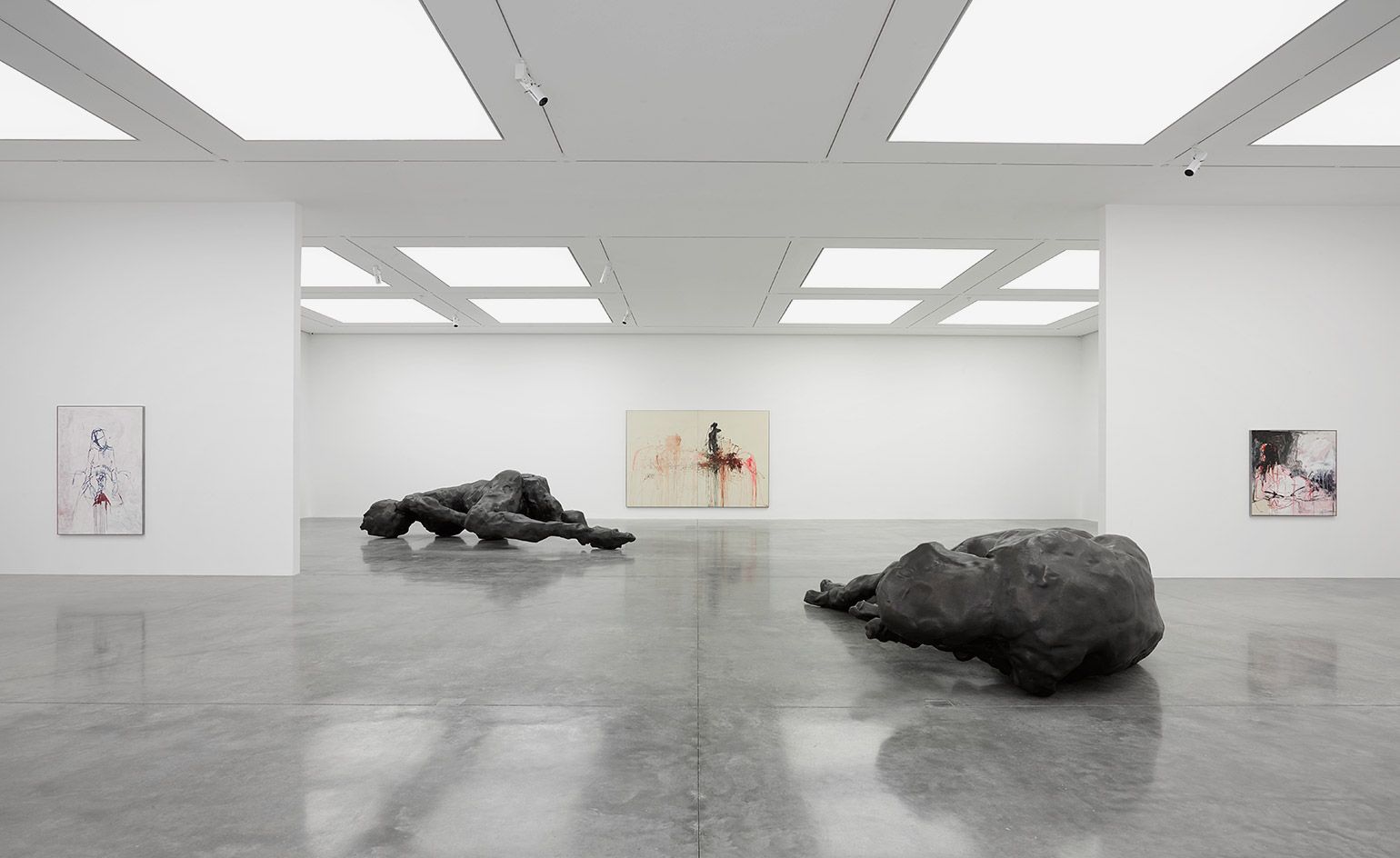
Look closer at My Bed (1998), the piece that made her infamous and nearly won her the Turner Prize. What critics called filthy—vodka bottles, used condoms, blood-stained sheets—was in truth a still life of breakdown. The stains and discarded objects were evidence of someone surviving herself. Visitors who expected irony instead found rawness. The work blurred the boundary between exhibitor and exhibited; spectators became voyeurs implicated in her suffering. It was not fiction. It was her actual bed, uncurated debris from a depressive binge that became art history. Few contemporary works have so publicly declared that private chaos is worthy of the museum.

My bed
That vulnerability has always been Emin’s power source. Even her neon texts, written in a trembling hand, glow with confession. Some snarl—anger rendered in light—while others whisper a bruised sort of hope. Knowing My Enemy, one of her best-known outdoor pieces, sits on a handmade timber shack that recalls the beach hut she once shared in Whitstable. The sculptures and the handwriting coexist like two halves of one letter: an address from her past to her future self.

Knowing my Enemy
So what happens when this forty-year conversation collapses into a single booth? Early descriptions suggest that Raw Confession Booth will fuse sculptural frame and written word, possibly illuminated by her trademark neon, and encourage viewers toward their own catharsis. The booth format is charged with religious resonance—a place for forgiveness, secrecy, rebirth. Yet Emin’s version will likely abandon absolution for honesty. Visitors might be asked to whisper their truths, to be heard and possibly recorded by the artwork itself. If My Bed made its audience her witness, this booth may make them her accomplices.
This mature Emin is both Royal Academician and survivor, still fearless in her self-exposure but more deliberate about its invitation. She is no longer only dramatizing trauma; she is architecting empathy. In a time when digital oversharing is effortless but rarely meaningful, Raw Confession Booth could restore weight to confession itself. It asks whether saying everything can still set us free—or at least make us feel seen.
Would you allow your untidy bedroom to be shown as art work in gallery?Choose below: |
Spotlight on Antigua, Guatemala
Eat
Start your day at El Comalote, a love letter to Guatemalan home cooking. Each tortilla is handmade from native corn—white, yellow, red, and even black—nixtamalized and toasted before your eyes. The scent alone pulls you in, but it’s the layers of flavor that keep you lingering: smoky beans, tender meats, and bright salsas cut from market-fresh produce.

La Merced Market
Explore
Wander over to La Merced Market, Antigua’s beating heart and a kaleidoscope of local life. Fruit vendors call out the day’s ripest mangoes, women in embroidered huipiles trade handmade crafts, and the air buzzes with the rhythm of conversation and cooking. It’s a sensory immersion into Guatemalan tradition, where the pastel façade of La Merced Church frames your path and each corner reveals another swirl of color. For the curious traveler, this is where culture happens—loudly, proudly, and deliciously.

Rincon Antigüeño
Unwind
Just beyond the tourist bustle hides Rincon Antigüeño, a local legend for its wood-fired chicken, or pollo a la leña. Here meals arrive with handmade tortillas and slow-simmered stews that hum with spice and smoke. The setting is humble, the prices forgiving, and the flavors unforgettable. It’s the kind of place where lunch stretches into conversation, musicians tune up in the background, and you feel folded into the city’s rhythm.
Thank you for reading! Adios!
Health That Fits Real Life

Most of us don’t need another routine. We just need something that works. AG1 Next Gen supports gut health, fills common nutrient gaps, and helps maintain steady energy with one daily scoop. Simple, fast, and easy to stick with. Start with AG1 today and get bonus Travel Packs in your Welcome Kit.
How would you rate todays edition of the newsletter? |